2025 San Diego Real Estate Market Year in Review: What Actually Happened — and What Comes Next
The San Diego housing market in 2025 didn’t behave the way many headlines predicted.
The San Diego housing market in 2025 didn’t behave the way many headlines predicted.
Despite persistent talk of falling prices and affordability pressure, the market proved more resilient, more selective, and more strategic than expected. Activity slowed, negotiations returned, and buyers became payment-focused — but the region did not experience broad price declines or distress.
Instead, 2025 marked a transition year: away from urgency and toward discipline.
This review breaks down what actually happened in the San Diego real estate market, how buyers and sellers adapted, and what these shifts mean heading into 2026.
The Biggest Misconception of 2025
“Mortgage rates will force home prices down.”
That assumption drove much of the narrative entering 2025 — but it didn’t fully materialize in San Diego.
Mortgage rates spent much of the year in the mid-6% range and dipped to 6.15% by year-end, a level that remains below the 50-year historical average for 30-year fixed loans. While rates constrained monthly payments and reduced buyer volume, they did not create excess supply or trigger forced selling.
What changed was how homes sold — not whether they sold.
The Reality of the San Diego Housing Market in 2025
San Diego’s housing market remained defined by structural undersupply, strong long-term demand, and sharp differences between well-positioned homes and the rest.
Buyer urgency declined
Time on market increased
Negotiation returned
Pricing became more precise
But prices largely held — especially in desirable neighborhoods and for move-in-ready homes.
This wasn’t a distressed market. It was a more balanced and more deliberate one.
How Mortgage Rates Fit Into the Bigger Picture
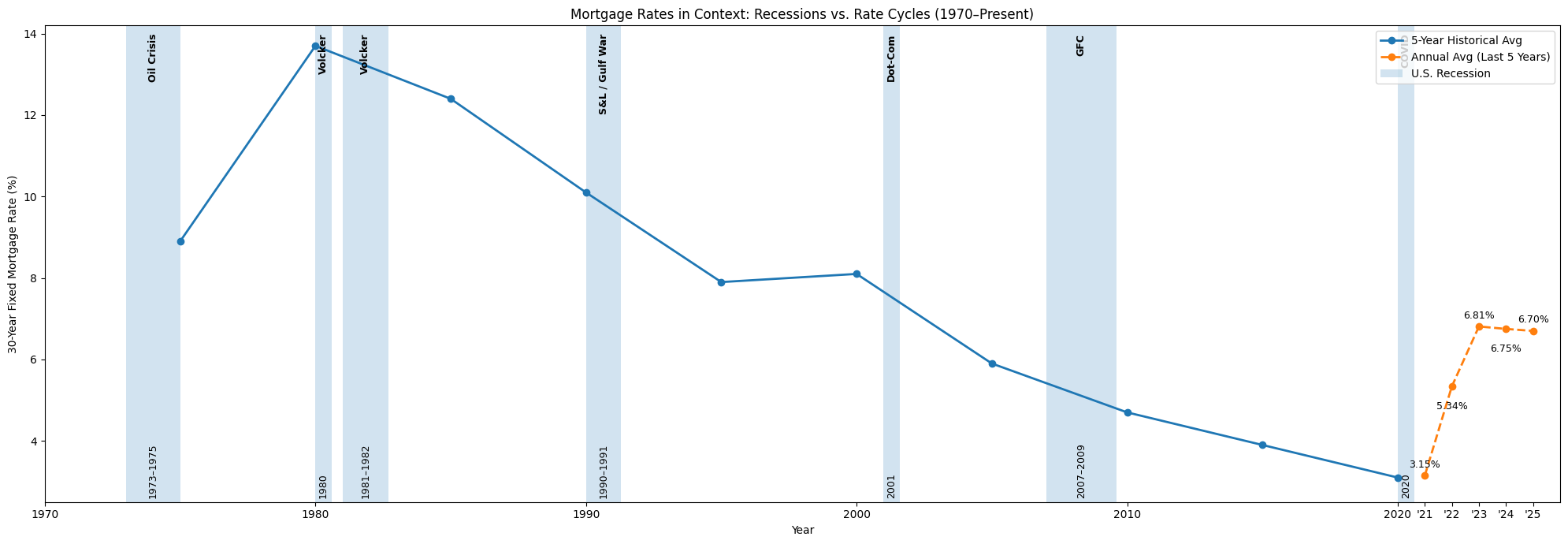
This chart shows why 2025 felt uncomfortable — but not unprecedented.
Over the past five decades, mortgage rates have moved through oil shocks, inflation cycles, recessions, and policy resets. When viewed in context, 2025 rates sit closer to historical norms than to extremes.
The takeaway for buyers and sellers:
Rates shaped behavior and affordability, but they did not break the market.
What Buyers Experienced in the San Diego Market in 2025
Inventory Expanded — Then Tightened
Inventory climbed through spring and early summer before compressing sharply into year-end.
Spring buyers had more options — but faced higher monthly payments
Late-year buyers saw fewer choices, which helped stabilize prices
This dynamic rewarded patience early in the year and decisiveness later.
A “Two-Speed” Market Emerged
Homes that were:
Properly priced
Well presented
Located in strong micro-markets
Sold efficiently.
Homes that missed on price or condition stalled, reduced, or required concessions.
Affordability Drove Decisions More Than Price Forecasts
Buyers weren’t waiting for prices to crash. They were managing payments.
Common buyer strategies included:
Requesting seller credits or rate buydowns
Closely evaluating HOA fees and insurance costs
Favoring move-in-ready properties
Negotiating more aggressively on inspections
How Affordability Played Out Locally vs. Nationally
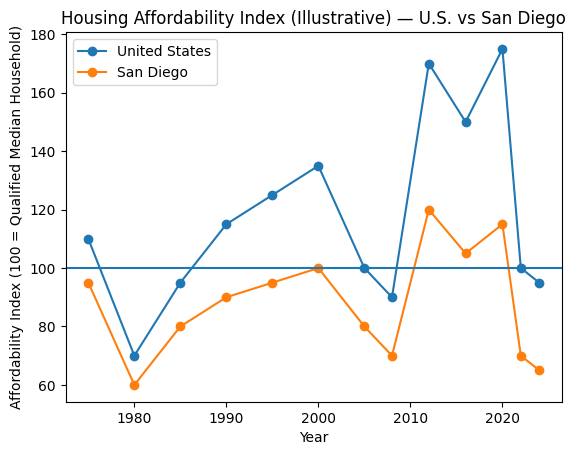
This visual highlights a key reality of 2025:
Even as national affordability improved modestly at times, San Diego remained structurally less affordable due to higher prices and limited supply.
That gap explains why buyer behavior shifted — but prices did not collapse.
What Sellers Experienced in the San Diego Housing Market in 2025
Price Resilience Without Automatic Appreciation
San Diego did not deliver broad, automatic price growth in 2025.
Appreciation became:
Property-specific
Location-driven
Condition-dependent
Homes priced correctly sold. Homes priced aspirationally paid the price through time or concessions.
Strategy Mattered More Than Ever
With list-to-sale ratios near 97–98%, sellers either:
Priced accurately and sold efficiently, or
Overpriced and negotiated later
Preparation, presentation, and pricing replaced momentum as the drivers of success.
What Actually Changed — and What Didn’t
What Changed in 2025
Homes took longer to sell
Negotiations became standard again
Inventory briefly improved
Quality and condition were rewarded
What Stayed the Same
Desirable areas remained supply-constrained
Prices proved resilient
Buyer demand persisted — but became payment-driven
The Data Behind the Market (San Diego County | 2025)
Home Prices (12-Month Averages)
Median Price
Detached: $1,050,500 (flat YoY)
Attached: $670,000 (-0.7% YoY)
Average Price
Detached: $1,412,729 (+1.8% YoY)
Attached: $815,770 (+1.1% YoY)
Market Velocity
Detached DOM: 38 days (+21.4% YoY)
Attached DOM: 42 days (+29.0% YoY)
Negotiation
Detached: 97.7% of list price
Attached: 97.5% of list price
Inventory & Supply
Avg. active listings (Detached): 2,882 (+18.8%)
Avg. active listings (Attached): 2,016 (+32.5%)
Months of supply:
Detached: 2.3
Attached: 3.0
Mortgage Rates (2025)
Year-end low: 6.15%
Typical range: mid-6% to low-7%
Key Takeaways Heading Into 2026
Slower Does Not Mean Weak
Activity cooled, but pricing held in a supply-limited county.Micro-Markets Matter More Than Headlines
Neighborhoods, condition, HOAs, and insurance costs now drive outcomes.Seller Success Requires Strategy
Preparation, pricing discipline, and proactive concessions outperform reductions.Buyer Leverage Comes From Preparation
The strongest buyers understand payments, move decisively, and negotiate intelligently.
San Diego Real Estate Outlook & Personalized Strategy
If you’re planning a move in 2026 — whether buying or selling — the right strategy depends on price, payment, timing, and micro-market dynamics.
If you’d like a personalized plan built around your goals, neighborhood, and comfort zone, I’m happy to walk through the numbers with you.
Reach out anytime.